


Release Notes IDS peak 2.13
Introduction
These release notes describe the changes in IDS peak 2.13. This version introduces a .NET interface under Linux as well as enhancements to the IDS peak Cockpit and the transport layers.
IDS peak 2.13
New and changed functions
IDS peak Cockpit
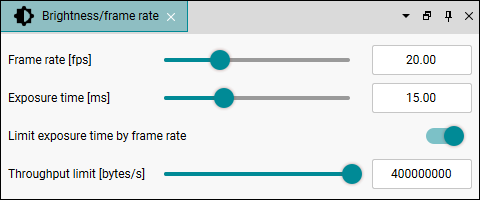
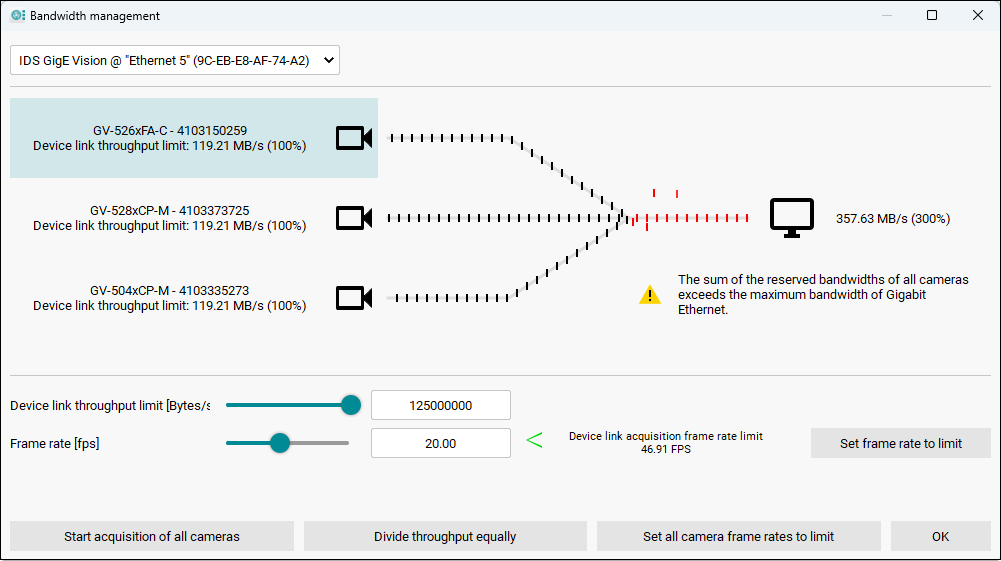
- The throughput limit setting was added to the "Brightness/frame rate" dialog. You can now limit the bandwidth of a specific camera directly. As before, you can still use the “Bandwidth management” dialog to set the bandwidth for multiple cameras.
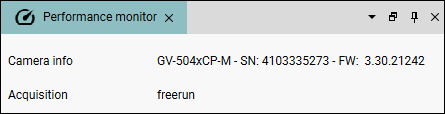
- The “Performance monitor” dialog shows information about the camera model and the firmware version on the top.
- You can zoom with finer increments in the camera window (key combination: CTRL + Shift + mouse wheel).
IDS peak comfortSDK
- Added new functions to control binning and decimation via the respective engine (sensor or FPGA).
- Added new functions to control binning and decimation in the image processing pipeline.
- Added new functions to use image scaling.
- Added new functions to get a list of supported pixel formats for sharpness measurement.
IDS peak genericSDK
- The
FileAdapterclass enables access to files in the camera's permanent memory. It offers convenient functions for reading, writing and deleting files. - New convenience functions have been added to the IDS peak genericSDK to simplify access to nodes and the NodeMap.
GEV Transport Layer / U3V Transport Layer
- With the new nodes in the OIDMonitor category, you can query extended information on the network card, network interface and packet information. OIDMonitor is only available when you use the kernel version of the GigE Vision Transport Layer (GEVK) under Windows.
uEye Transport Layer
Additional features have been added to the uEye Transport Layer to enhance the operation of uEye cameras (UI models) under IDS peak:
- Use the sensor internal image scaling with ScalingSelector (model-dependent).
- You can use the uEyeROI node to quickly set an ROI (region of interest) with a single command.
General improvements
- Introduction of a .NET interface under Linux: .NET enables the platform-independent development of applications for Linux and Windows. From IDS peak 2.13 on, it is possible to develop .NET applications under Linux. The ReadMe describes how to install the .NET interface of IDS peak under Linux. To use the .NET interface, .NET 5 or higher is required.
Component versions used in IDS peak 2.13
| Component | Version Windows | Version Linux |
| IDS peak comfortAPI | 1.10.0.0 | 1.10.0.0 |
| IDS peak genericAPI | 1.10.0.0 | 1.10.0.0 |
| IDS peak IPL | 1.13.1.0 | 1.13.1.0 |
| IDS peak AFL | 1.6.1.0 | 1.6.1.0 |
| IDS peak Cockpit | 2.1.0.0 | 2.1.0.0 |
| Tool Device Command | 1.4.5.0 | 1.4.5.0 |
| Tool Device Update | 1.4.6.0 | 1.4.6.0 |
| Tool IP Config | 1.4.5.0 | 1.4.5.0 |
| Tool Device Password | 1.0.2.0 | 1.0.2.0 |
| Support Tool | 1.2.0.0 | 1.2.0.0 |
| DirectShow | 0.3.0.1 | - |
| GenTL GigE Vision user space | 1.17.0.0 | 1.17.0.0 |
| GenTL GigE Vision kernel | 1.17.0.0 | - |
| GigE Vision kernel driver (WHQL) | 1.6.2.0 | - |
| GenTL USB3 Vision user space | - | 1.17.0.0 |
| GenTL USB3 Vision kernel | 1.17.0.0 | - |
| USB3 Vision kernel driver (WHQL) | 1.6.0.0 | - |
| GenTL uEye (uEye Transport Layer) | 1.17.0.0 | 1.17.0.0 |
| GenICam | 3.4.1.1 | 3.4.1.1 |
Status: 2024-10-31