


ToF becomes high-resolution
Modern iToF technology brings 3D image processing into motion
Not every application needs a high-end system – but it should not have to compromise on quality. Until now, there were only two options for industrial 3D image processing: powerful but expensive, or inexpensive but with compromises in resolution and image quality. However, new highly integrated iToF sensors with high resolution and integrated real-time data processing offer cost-sensitive applications fast, user-friendly access to precise 3D technology. Is this more than just a solution for a gap in the market that could become the first choice for cost-sensitive but also demanding 3D applications?
The three-dimensional capture of scenes and objects is a central component of modern industrial automation. Methods such as active stereovision based on pattern projection have proven to be particularly effective – especially when maximum detail, resolution and the handling of complex surface structures are required. Using projection-based image correlation, such systems capture many reliable image points even on difficult surfaces, enabling precise triangulation and detailed depth maps. This means that you remain at the cutting edge of image-based measurement technology.
At the same time, time-of-flight technology has undergone a remarkable maturation process in recent years. While ToF cameras were previously used primarily for simple distance measurements, they were only suitable for many industrial applications to a limited extent due to their limited resolution, range or integration capability. Limited ranges, low resolution, high sensitivity to ambient light and the inability to correctly detect the depth of moving objects significantly restricted their practical use.
3D entry-level camera with integrated depth processing
With the advent of more powerful sensor architectures, such as the new AF0130 iToF sensor from onsemi, with back-illuminated pixels (BSI technology), global shutter, improved signal processing and integrated evaluation electronics, the situation has changed significantly. New iToF camera models with intelligent pixel management therefore not only enable higher depth resolution and ranges, but also cope with difficult lighting conditions much more robustly.
At the same time, the system logic is shifting: Instead of sending raw data to an external computer, the sensors themselves perform essential processing steps – such as calculating depth images, intensity values and confidence maps directly on the chip. This trend towards highly integrated 3D processing at the sensor itself not only makes ToF cameras more powerful today, but also significantly easier to integrate – a decisive step towards intelligent, compact 3D vision systems for broad industrial use.
Precision in resolution and depth
The quality of a 3D measurement depends not only on the number of pixels captured, but above all on the accuracy of the depth data. The new IDS 3D camera utilises the 1.2 megapixel AF0130 sensor from onsemi, delivering high XY resolution – ideal for scanning finer surface details across the area. However, another factor is crucial for actual depth precision: the modulation frequency of the light signal, which significantly determines the accuracy and range of phase-based ToF systems. Compared to standard cameras on the market, onsemi enables frequencies of up to 200 MHz – a clear advantage. This is because the measuring range is divided into smaller intervals, resulting in better depth resolution. Put simply: The higher the frequency, the more finely the camera can detect differences in phase position, and thus measure small changes in distance more accurately.

Another advantage: At high frequencies, the system becomes less susceptible to interference from ambient light – a critical factor for many industrial applications outdoors or in rapidly changing light conditions. The ability to modulate at frequencies up to 200 MHz, as enabled by the onsemi AF0130, thus creates significant technical scope. At close range, a high frequency can ensure maximum accuracy. In the long-range area, on the other hand, the frequency can be specifically adjusted to achieve long ranges with stable depth resolution. This scalability makes the system more flexible – a significant advantage over traditional ToF sensors with a fixed, usually low modulation frequency.
High image quality in difficult lighting conditions
Another application-relevant feature of the new onsemi sensor is its high sensitivity in the near-infrared range at 940 nm – a wavelength range that is significantly less affected by sunlight than, for example, 850 nm. The iToF camera used by IDS specifically exploits this property and works with a laser tuned to 940 nm. The result: particularly high interference light suppression and stable 3D measurements even under difficult lighting conditions. This makes the camera ideal for outdoor applications, where direct or changing sunlight has often been a problem in the past.
Optics play a key role in ensuring that the 3D cameras can reach their full potential here. It is crucial to use a lens that has been specially optimised for the camera's wavelength range. This is the only way to ensure that light output and image quality remain consistently high even in difficult lighting conditions, such as outdoors. In addition, an aspherical lens ensures uniform sharpness across the entire image field and reduces optical distortions, which noticeably improves image quality and eliminates the need for time-consuming post-corrections. For versatile industrial applications at close range and long distance, the lens must be designed to provide consistent sharpness from short distances to long distances – without the need for refocusing.
The challenge – 3D data of moving objects
The ability to reliably capture even moving scenes is increasingly becoming a key criterion for the use of industrial 3D cameras. This is precisely where many conventional technologies have reached their limits up to now. Particularly in structured light methods or stereo-based systems, movement can lead to artefacts or measurement errors – for example, through multiple exposures, blurring or incorrect correlation of image pairs. For many applications involving dynamic processes, fast-moving objects or conveyor belt speeds, this has meant either living with limitations or resorting to complex, expensive specialised solutions.
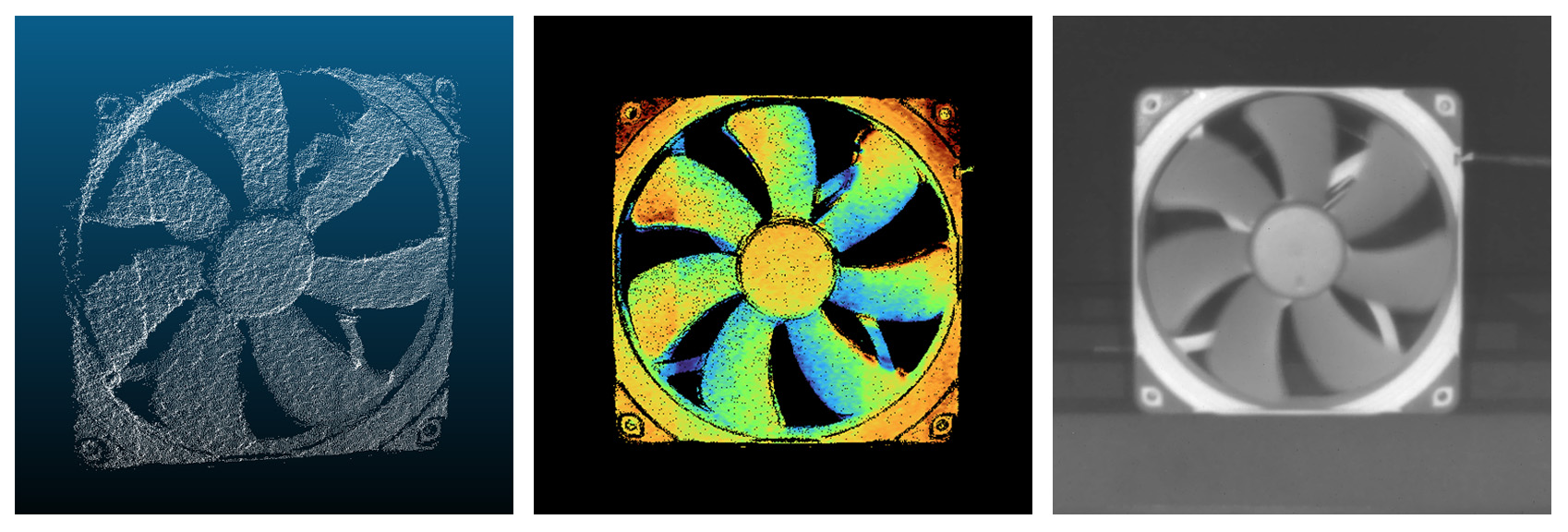
3D cameras with integrated data processing and global shutter capabilities offer a fundamental paradigm shift in this area. Since depth information is captured directly onboard per pixel and evaluated in real time, many of the motion-critical processing steps after data transfer to the PC are no longer necessary. Modern sensors such as the AF0130 enable seamless 3D detection even with moving objects, without compromising accuracy or response time. This is particularly beneficial for applications such as robotics, logistics, packaging and quality assurance in ongoing production. Without the need to stop conveyor belts or robots, production processes can run much faster and more efficiently, and throughput can be increased.
To calculate a single depth value, four coordinated exposures with different phase positions (typically 0°, 90°, 180° and 270°) are usually necessary. These four signals are then used to calculate the phase shift – and thus the distance. Thanks to its special pixel architecture and integrated on-chip processing, the AF0130 iToF sensor captures all four phase images in quick succession and stores them directly and completely in the chip's memory – without any intermediate readout. This significantly shortens the time between exposures and noticeably reduces motion blur. Another advantage of continuous reading: The depth information can be efficiently re-sorted and directly processed further – without time-consuming post-processing. This not only makes the camera more robust against movement, but also enables higher frame rates and reduces the load on the host system. This is a decisive advantage, particularly in dynamic applications such as robotics, logistics or pick-and-place.

Smart iToF – a technology component with the potential to drive the market
With the Hyperlux sensor, onsemi has achieved a significant milestone in the development of iToF technology. The integration of global shutter, internal memory and on-chip depth processing addresses key challenges of traditional ToF systems, such as limited range, ambient light sensitivity and system-side latencies. This makes iToF interesting for applications that previously relied on different 3D technologies. However, a powerful sensor alone is not enough to create a standard-setting camera solution. The decisive factor is the coordinated interaction between optics, electronics, software and system integration.
onsemi therefore focuses specifically on close cooperation with experienced camera manufacturers – such as IDS, which has been deeply rooted in the industrial 3D camera market for many years. The resulting uEye 3D camera exemplifies how the potential of Smart iToF technology can be translated into a practical overall system. As a result, iToF is increasingly evolving from a supplementary solution to a serious alternative in industrial 3D image processing – especially when ease of use, high integration capability and stable results under variable operating conditions are required.
Further information
- First insights into the performance of the Nion 3D camera – learn about the advantages of iToF technology and find out how easy it is to calibrate a 3D workspace and capture your first 3D image with IDS Cockpit: To the video
- Time-of-flight taken to a new level – discover the advantages of Nion: To the product information page