

What is the difference between ToF, stereo vision and structured light?
Abstract
Time-of-flight (ToF), stereo vision and structured light differ primarily in their measurement principle, accuracy and suitability for specific applications.
ToF is particularly suitable for fast 3D acquisition in real time and for moving objects.
Stereo vision is useful when precise point clouds and a flexible measurement range are required.
Structured light offers the highest level of detail and is frequently used for measurement and inspection.
Which method is most suitable depends on requirements such as speed, accuracy, range and ambient light.
Why is depth data required?
In industrial image processing, two-dimensional images are often insufficient. Applications such as bin picking, robotics, quality control or autonomous navigation require additional depth data to reliably determine distances, positions and the spatial extent of objects. This allows machines not only to recognise which objects are in a scene or what features they possess, but also to capture their spatial position, distance and volume. This enables, for example, precise robot control.
Time-of-flight (ToF), stereo vision and structured light pursue different technical approaches to depth sensing. However, they share a common outcome: They generate depth maps or three-dimensional point clouds from which spatial information can be derived.
How does time-of-flight (ToF) work?
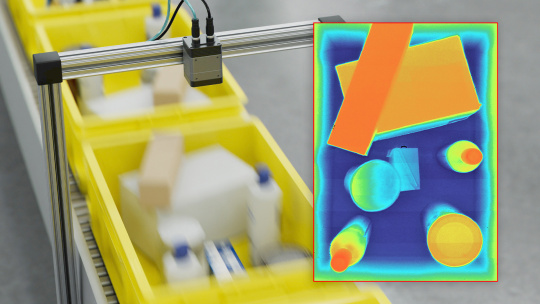
Time-of-flight cameras operate on the principle of active distance measurement. The camera emits light and measures how long it takes for the light (usually from a laser) to reach the object and return to the sensor. This information can be used to calculate the distance to the object.
In principle, a distinction is made between direct and indirect time-of-flight measurement. In direct time-of-flight measurement, the actual time required for the light to travel to the object and back is determined. However, industrial ToF cameras are often based on so-called indirect time-of-flight (iToF). In this method, the distance is calculated from the phase shift between the emitted and received light signal.
A significant advantage of ToF systems is that depth information can be captured for every pixel simultaneously. With iToF, high image resolutions with very high frame rates are possible. This makes ToF cameras particularly suitable for fast processes and moving objects.
Strengths of time-of-flight
- Fast 3D acquisition in real time
- Depth information for all pixels in one image
- Well suited for moving objects
- Comparatively simple system integration
- Robust distance measurement across larger working ranges
- Cost-effective solution for many industrial 3D applications
Limitations of time-of-flight
- Typically lower accuracy than high-resolution stereo or structured light systems
- Multipath effects can influence measurement results
- Reflective surfaces can reduce measurement quality
- Dependence on active illumination
- Measuring range is limited by sensor and lighting technology
How does stereo vision work?
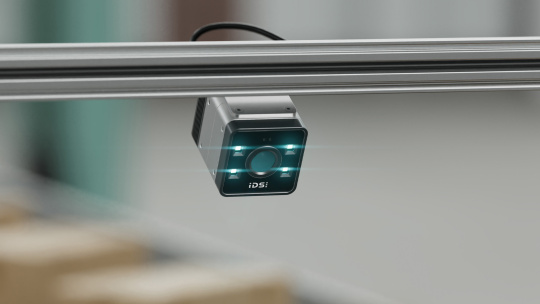
Stereo vision is based on human vision and uses at least two cameras that capture the same scene from different angles. Depth is calculated from the image differences using triangulation. The distance of an object is determined based on geometric relationships between the camera positions.
In passive stereo vision, depth determination is carried out exclusively based on existing image features. The method works particularly well when the surface of an object has sufficient structure or texture.
Active stereo vision systems are frequently used for texture-poor, monochrome or reflective surfaces. In this process, a projector projects a random or defined pattern of dots onto the scene, so that depth calculation functions reliably even under difficult conditions.
Active stereo vision thus bridges the gap between traditional stereo vision and structured light. Modern industrial 3D cameras combine the advantages of triangulation with targeted texture projection.
Strengths of stereo vision
- High measurement accuracy, robustness
- Detailed point clouds
- Flexible adaptation to different measuring ranges
- Ideally suited for bin picking
- Active stereo also works with texture-poor (smooth or monochrome) objects
Limitations of stereo vision
- Calibration is more complex than with ToF systems
- Higher computational load
- Passive stereo requires sufficient surface texture
- Occluded areas can cause gaps in the data
- Moving objects can affect measurement quality
- More sensitive to ambient light
How does structured light work?
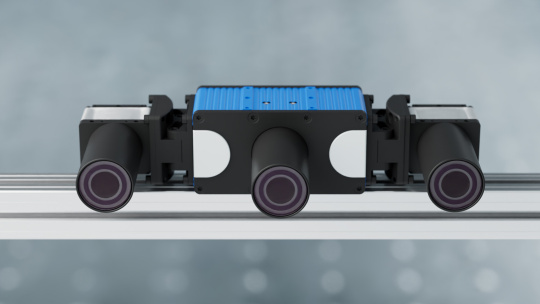
Structured light systems project defined light patterns onto an object. Typical patterns include stripes, lines or grid structures. A camera subsequently captures the deformation of these patterns on the object surface.
As the shape and position of the projected pattern are known, the geometry of the object can be calculated with a high level of precision. Structured light is also based on triangulation, but additionally uses the active projection of a known pattern.
The controlled projection enables highly detailed surface reconstructions to be generated Therefore, structured light is frequently used for measurement and inspection tasks.
Strengths of structured light
- Very high measurement accuracy
- Detailed reconstruction of surfaces
- High resolution of 3D data
- Suitable for measurement and inspection tasks
- Excellent results with small to medium-sized objects
Limitations of structured light
- Sensitive to strong ambient light
- Moving objects make measurement difficult
- Usually limited range
- Additional projector required
- Greater system complexity
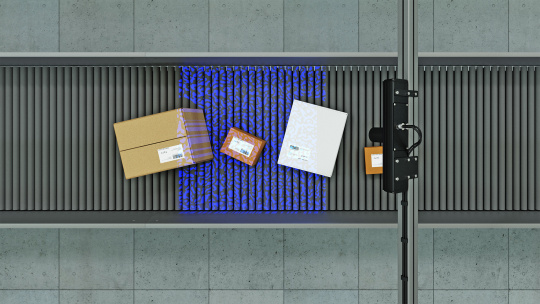
How do ToF, stereo vision and structured light differ?
Criterion |
ToF |
Stereo vision |
Structured light |
|---|---|---|---|
Measurement principle |
Time-of-flight or phase shift |
Triangulation using multiple camera images |
Pattern projection and triangulation |
Range |
medium to high |
flexible |
short to medium |
Accuracy |
medium to high |
high |
very high |
Moving objects |
very well suited |
well suited |
limited |
Ambient light / outdoor |
well suited |
well suited |
less suitable |
Textureless surfaces |
well suited |
well suited (active) / limited suitability (passive) |
very well suited |
System complexity |
low |
medium |
high |
Relative costs |
low |
medium |
medium to high |
Which 3D method should I choose?
When fast depth acquisition in real time is required and moving objects also need to be reliably detected, time-of-flight is often the first choice. The method provides depth data with just one capture, is often comparatively cost-effective to implement and is well-suitable for robotics, logistics and automation applications.
When high-resolution point clouds and precise 3D data are required, stereo vision often offers the best balance between accuracy and flexibility. Active stereo vision systems also enable the reliable detection of objects with low surface texture and have become well-established in bin picking.
Where maximum measurement accuracy and a particularly detailed reconstruction of surfaces are required, structured light is frequently used. The method is particularly suitable for surveying, testing and inspection tasks.
The choice of the suitable 3D method depends on the requirements of the respective application. Decisive factors here include accuracy, speed, range and ambient conditions.
Application |
Recommendation |
Justification |
|---|---|---|
Bin Picking |
Stereo vision |
Provides detailed point clouds for reliable object and grip point detection. |
Palletising and logistics |
ToF or stereo vision |
Large working areas and fast 3D scanning are the priority. |
quality control |
Structured light |
Particularly suitable for precise geometric and surface measurements. |
Robotics and navigation |
ToF |
Real-time distance measurement even in dynamic environments. |
Medical measurement |
Stereo vision or structured light |
High accuracy in capturing surface structures. |
Agriculture and outdoor applications |
ToF |
Well-suited for longer distances and changing environmental conditions. |
Which IDS products supports these methods?
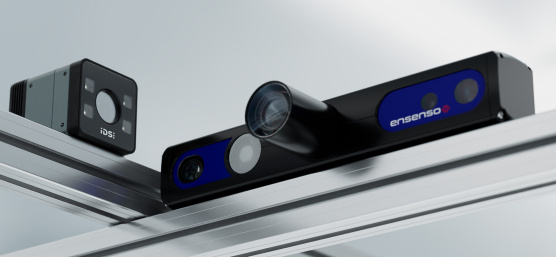
IDS offers both 3D cameras based on time-of-flight and active stereo vision systems, thereby enabling solutions for a wide spectrum of industrial 3D applications.
Ensenso: active stereo vision for precise 3D data
Ensenso cameras are based on active stereo vision and combine stereo cameras with an integrated texture projector. This enables objects with little surface texture to be reliably detected.
For applications such as bin picking, robotics or automation, the FlexView technology additionally supports the generation of denser and more complete point clouds by merging multiple images.
Typical applications
- Bin picking
- Robotics
- Automation
- Object recognition
- Quality control
Find out more:
Nion: indirect time-of-flight for real-time 3D capture
The Nion 3D ToF cameras are based on the indirect time-of-flight method and provide high-resolution depth data in real time. The integrated 1.2 MP ToF sensor enables fast and reliable 3D capture, even with moving objects and in challenging environmental conditions.
With an IP code of IP67 and suitability for outdoor use, the cameras are optimally suited for industrial applications in sectors such as logistics, robotics, and automation.
Typical applications
- Mobile robotics
- Logistics
- Navigation
- Palletising
- Automation
Find out more:
How does IDS cover structured light applications?
Many applications that are traditionally implemented with structured light systems can now also be realised with active stereo vision. By combining triangulation and texture projection, Ensenso systems cover a wide range of application such as bin picking, robotics and industrial 3D inspection.
If you have any questions about choosing the right 3D method or implementing specific applications, our team will be happy to assist you.

Since 2011, Oliver Senghaas has served as Head of Marketing at IDS, driving the company’s global marketing strategy. He is responsible for corporate communications, brand management, digital campaigns, the content and functional development of the company websites and B2B web store, as well as the creation of technical documentation. His focus is on combining technology and creativity to position IDS clearly in the field of industrial image processing.
Vision Channel
Videos and live sessions about machine vision.
Your project
How can we support you in your project? Together we will find the right solution for you!
Newsletter
Stay up to date and subscribe to our newsletter.